Showing posts with label nourishing traditions. Show all posts

Thursday, May 12, 2011

Yeasted Buttermilk Bread

This is another recipe from my favorite cookbook "Nourishing Traditions". It's a soaked bread. I tried it once before, before I had my sourdough ready. This weekend, I made both sourdough and this bread. Not sure what I was thinking...but sometimes I don't think. I loved this last time I made it. The flavor is more yeasty than I've ever been able to get my wheat bread to taste like. It's soft and moist. But I still have yet to get it to rise for some reason! I actually had to let it sit overnight since it got to be too late and still hadn't risen. When I woke up, it had risen an inch or two. The top was barely to the top of the loaf pan. I baked them anyway while I was getting ready for work. I pulled them out of the pans and threw them in the toaster oven (it was off) so they could cool and not be eaten by dogs while I was at work. I didn't get a chance to taste it until I got home from work. Yummy! It may not rise well (YET) but it just tastes and feels so good in my mouth that this is my new favorite bread.

It's in the mid 90's here this week and we won't be turning the AC on for a while. So we decided that cold sandwiches sounded good for dinner last night. I gave Adam the choice of the sourdough bread, the soaked bread (this one) and his regular, storebought bread. He asked for the soaked bread. This is the first bread I've made that he's chosen over his storebought bread so I definitely consider this one a success. It's healthy and we'll both eat it. I just have to experiment and make it rise, then it will be perfect.


Yeasted Buttermilk Bread


4 c. whole wheat flour
1-1 1/2 c. buttermilk, warm
1/2 c. melted butter
1/4 c. room temperature water
2 1/4 tsp. SAF yeast
2 Tbs. honey
1 tsp. salt
1/2 tsp. baking soda
1 c. unbleached white flour

Method:

Warm buttermilk over low to medium heat until finger temp (body temperature). Pour buttermilk out of pan and melt butter.

Combine flour, 1 cup buttermilk and melted butter in a food processor until a ball forms. If dough is too thick, add buttermilk, but it should be thick enough to form a ball. Place in a bowl, cover with a towel and rest on the counter 12-24 hours.

The next day, combine water, yeast and honey in a small bowl and leave for 5 minutes or until it bubbles. Add salt and baking soda and mix well. Place half the flour mixture, half the yeast mixture and 1/2 cup white flour in food processor. Process until a smooth ball forms. Repeat with other half.

Knead the two balls together briefly. Place in a buttered bowl, cover with a towel and allow to rise two hours or until doubled. Punch down, cut the dough in half and process each half in a food processor for 30 seconds each. Form into loaves and place in buttered loaf pans. Cover with a towel and let rise 1-2 hours, until doubled. Bake for 30 minutes at 350F. Cool on racks.

The use of the food proccessor is new to me for bread making, and usually I don't like to make things that rely on modern conviences...I'm weird like that...but I am so glad I gave this one a shot anyway because I really do LOVE this bread. There's very little hands on time (no hand kneading) but you need to plan ahead, for sure. I will be making this one often now.

Monday, April 4, 2011

fermenting (and other ramblings)

I have gotten really bad about updating my blog. So here's another nutshell, but all on one topic. Well, all on one topic except for a tiny little intro with something that makes me very happy. I got to use my clothesline for the first time this past weekend. It's just so pretty to see clothes/blankets flapping in the wind. They dried during the first 2 hour session of conference.


I have a lot more room on the lines than I thought I would. I was so sure it was going to be cramped...but then I've only ever had a single line, or 2 at times so I underestimated just how much I can fit on there! I was pleasantly surprised. That's a queen sized quilt and two loads of laundry. I don't think I'll ever run out of room.


And one more note. This weekend, I was able to watch General Conference. While I was watching, I was able to feel His spirit and that allowed me to forget, for a time, the heartache that has come with a stressful time for my family. He loves me. I know He does because he allows me, an unworthy, imperfect being, to feel His love for me and to recognize the numerous small things that He has given me to bring me joy, like watching a bird peck the ground for food, clothes flapping on the line that my loving husband built for me, a pantry full of food and too many other things to list but also, He has placed me in a family that is amazing. I often don't feel like I belong because there is nothing too special about me as there is about everyone else. They are such good examples to me about unconditional love and being there to support each other through life's trials. I am unworthy of all I have but He blesses me continually anyway and I am truly grateful!


So, back to the purpose of this post. Fermenting. The book I started following to change my eating talks a lot about fermenting fruits and vegetables (though mostly veggies since fruit turns to alcohol after just a couple months whereas veggies last anywhere from several months to a couple years.


Why would anyone want to ferment food, you wonder? I'm glad you asked. Fermented foods are loaded with lactobacilli, the same probitotic found in yogurt. Also, the veggies go through enzymatic changes that makes the food easier to digest. Strangely though, when eaten with meat, it actually helps to digest some of the vitamins in meat that would otherwise be unavailable to the body. Easier digestion means the whole digestive tract works much more efficiently. I wouldn't have believed that one except for that I know first hand how wonderfully that actually works!


There is that reason, but also, fermenting food is an ancient form of preserving foods for the winter when there would be no fresh produce. Sure, there's canning nowadays that wasn't available back then. But the high heat kills a lot of the vitamins that would be available in the fresh veggies, or fermented veggies. Anyone who knows me, knows I like to learn the "old ways". It truly makes me happy to learn these things.


Of course, these kinds of foods aren't without a downfall. The taste is not the same as the fresh/canned varities we're used to. I don't mind tastes I'm not used to but there are people who fight anything different and they are a hard sell! But I'm continuing to try to break through that barrier.


One thing to note: you lose the probiotic effect of these foods if they're heated...so that traditional dish of boiled sauerkraut and hot dogs, if the store bought stuff was even fermented to begin with, which is unlikely, wouldn't offer any probiotics unless some unheated sauerkraut was put on top of the dish. Anyway, you only need a small amount to get the effects so that would work.


Some of these experiments have been SO tasty and some have been downright disgusting but most are somewhere in the middle. So without getting into recipes on this post, I will show you what I've made and what I thought of them...recipes will come in another post, another time.


Asian veggie medley. This is the last one I made and I haven't actually tried this one yet but I like the dark color.


Orange marmalade. It's very liquidy (which the book warns you about). I could have handled that but the taste was so disgusting that I couldn't handle it at all! I read on someone's blog that it was too sour. I made one jar with peels and one without. I figured the peel is what made it sour. They were both equally disgusting...and bitter, not sour. I won't be sharing the recipe on this one ever.


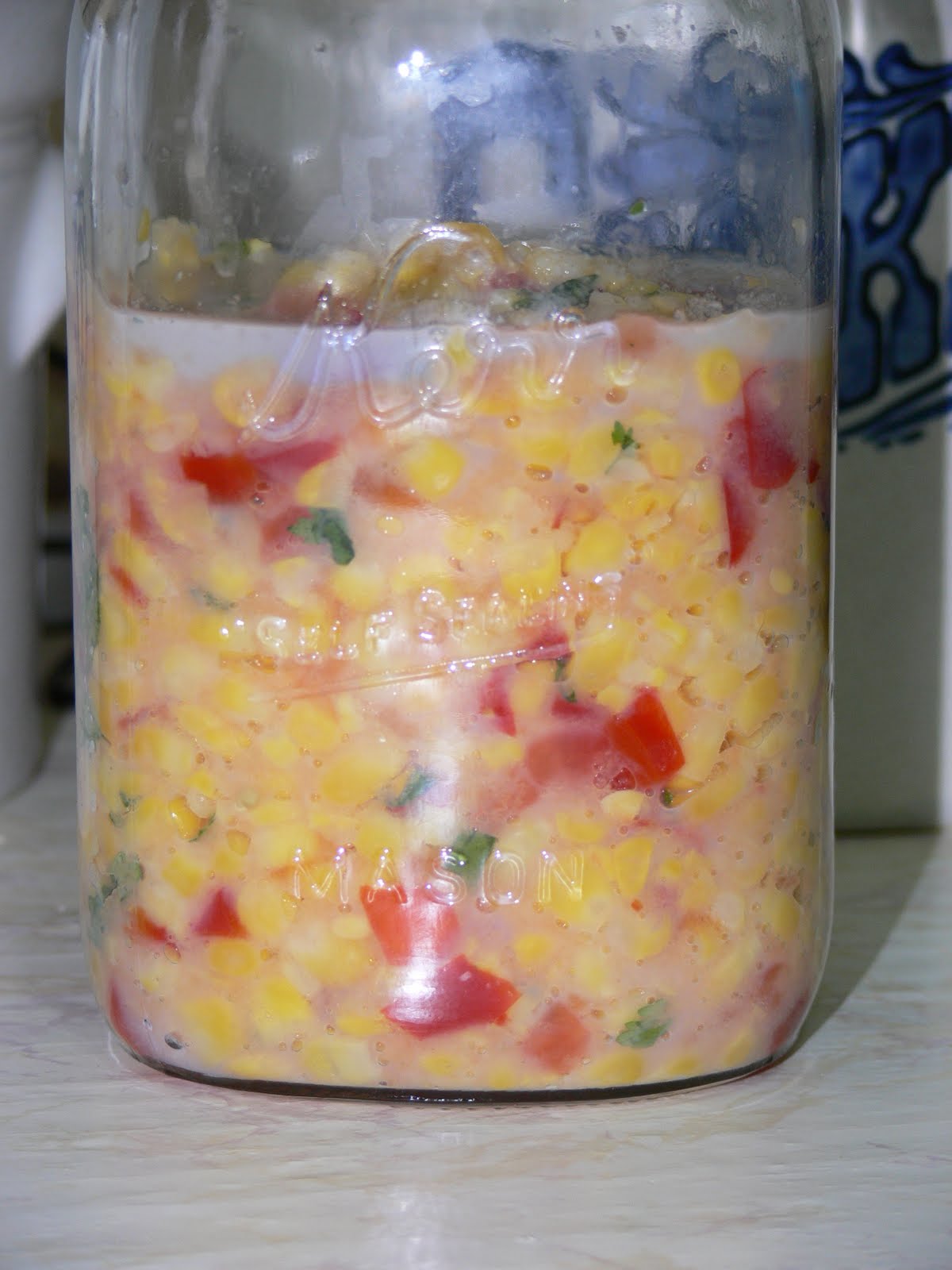
Corn relish. I liked this one well enough.


This is called cortido..it's a spicy, Latin American version of sauerkraut. I prefer sauerkraut but this works well with Mexican food.


Sauerkraut. Adam likes it well enough when it's completely fermented but when it's under-fermented, he says it tastes too much like cabbage for him. I really like sauerkraut. The sauerkraut needs about 5 months to really mature so I really need to do a whole crock full to actually keep it around long enough to reach 5 months.


Salsa. I made this one without onions for Adam. He hasn't tried it yet but I like it...not too spicy.


Pickles. Not a fan of this recipe but I've eaten them a couple times.


Ketchup. I like this! I pretty much stopped using ketchup (except for fries) because of the high fructose corn syrup. I don't like how sweet storebought can be anyway. This one has a little sweetner in it but you don't notice it really. It's more of a robust flavor...I like it.


Mango chutney. I commented on this in one other post. This is, by far, my favorite ferment so far...except for the bubbles (which is normal for chutneys and many other ferments). I just love it! It's sweet, spicy, salty, tangy...everything except bitter.


Now, here's the problem with fermenting...everything is supposed to stay beneath the liquid or it can mold. Her's those weird pickles a few weeks later. Only the portions above the liquid are affected but I haven't been able to bring myself to try the portions below the surface just yet. So far, this is the only one I've had problems with.

Thursday, March 10, 2011

mango chutney

I saved this post as a draft almost a week ago, I think because I didn't have the recipe for the chutney in front of me and I wanted to include it...but I never have it when I am ready to sit down and blog. So I will just have to come back another time and include the recipe (which I got from NT).

This recipe caught my eye after we had fish tacos with mango salsa. That was so yummy. So, I got what I needed and made up these 3 jars of mango chutney. The recipe said it would all fit in one jar...they lied. If I had known it was going to be so much, I would have made half of it without onions so Adam could eat some too.

I really think the ginger monster is so cute! Do you see him too?


This is a lacto-fermented food. So you incoluate it with lactic acid (the whey from yogurt) and let it sit on the counter for 3 days. It's bubbly...like soda. So that part I don't like but I don't notice it when I eat it on food.

I grilled some talapia on the George Foreman grill and topped it with some mango chutney. Yum!! Adam said to me, "Ewww, is that your onion chutney?" He has no idea what he's missing. I'll have to make the next batch without onions for him.

I've been making/eating a lot more lacto-fermented foods lately because of the health benefits they have. They loaded with probiotics (as long as you don't cook them) and bacteria for your intestines and colon. Also, I learned that they help break down something in the meat (though off the top of my head I can't recall what it is) that is hard for bodies to digest.

Monday, February 21, 2011

Kishk from Nourishing Traditions

Here's another recipe from "Nourishing Traditions". I LOVE that book. It is a cookbook but it's so much more. Dr. Weston A. Price was a dentist in the early 1900's. He noticed that people from different cultures had better teeth and were more healthy than people of other cultures. He had a theory that diet had a lot to do with that and began traveling the world, researching people's diets, mostly concentrating on people who were still eating their primitive diets. He studied not only what they ate but how they prepared foods. The healthiest groups of people had certain things in common in their diet. I don't know the list off the top of my head but those similarities included fermented veggies/fruits, soaking grains and beans to release phytic acid (some even ferment them as well), they included animal fat in their diet, and whatever I'm forgetting. I first learned about this guy when I was on the raw diet. There is a whole book that comprises his findings, and this book is like the how to of his findings. The first pages give a brief overview and each chapter has information on that particular subject. And on the side of each page has more information. It's the kind of book I could sit down and read...and often do. It's my night time reading. It's a great book but can be very overwhelming when I think about all I'm supposed to be doing.

Like any change, it's best to take baby steps. So my first step was to do some lacto-fermenting. I've made several batches of sauerkraut and a couple of dilly carrots. I've not mastered it in any way, shape or form but I have started. So, now that I am comfortable with fermenting, I can add to it. I have chosen to add soaking grains. For some reason, it's the most intimidating of all. I'm not really sure why. So, my first attempt at soaking is actually one that also ferments. Kishk comes from the Middle East. And it's a super simple recipe...a good one to start with.

4 cups bulgur
4 cups plain yogurt
(I cut it in half in case I really didn't like it)

Mix them together in a bowl and put in a dark place to ferment for 24 hours, covered. Make sure there's extra room in the bowl because it will expand to about twice the original volume.


Spread the mixture on cookie sheets and put in the oven which should be set to the lowest setting. I would dry it that way for an hour or two then just leave them in the oven for several hours to continue drying. The recipe says 12 hours but I didn't need nearly that long.


You can store it on the shelf in an airtight container after it dries but if you plan on having it around for months, it might be better off in the fridge/freezer. For me, I plan on replacing my bran flakes with it so one batch won't be around long enough to have to worry about the fridge.


I tasted it for the first time yesterday. It has a subtle sour flavor to it when eaten alone but when mixed with fruit and milk, you don't really notice it. It does not get soggy at all! It takes a lot more chewing to get through this bowl than it does to get through a bowl of bran flakes...which is probably a good thing anyway since I tend to inhale breakfast.

Next batch (which will be very soon), I will try it before I dehydrate it. If I like that better, than I'll forego the dying step. I can keep a container of it in the fridge to slow down the fermenting process so the flavor doesn't get too sour.

Wednesday, January 19, 2011

Little Miss Muffet

Again, I got this from the book "Nourishing Traditions" that I got for Christmas. This recipe makes "cream cheese" and whey. The cream cheese can be used like you would use cream cheese except that it is kind of gritty when cooked in a dish. Maybe if I used whole fat yogurt that wouldn't be the case but I have no experience so can't say for sure. It's healthier though because it's full of probiotics unlike real cream cheese. The whey is what I use to lacto-ferment things like sauerkraut and the carrots that I really like. Also, you can put some in the soaking water for beans and it helps to lessen the things in beans that give you gas.


It's super simple to make. You take a muslin cloth, or a few layers of cheese cloth, draped over a bowl. Dump the yogurt into the cloth.


Tie up the ends and hang it above the bowl.


This is what's left over. The cream cheese lasts a few weeks and the whey lasts a few months.
Related Posts with Thumbnails